PILGRIMAGE TO FREEDOM
By Ermance Rejebian
Aurora – Oct. 15………
The story of Vahram Rejebian is the story of many
Armenians
who migrated to the United States in search of the human
dignity denied them in their own lands. The age-old
horror of genocide became a shocking reality to the
modern world for the first time following World War I,
when hundreds of thousands of Armenians were
slaughtered by the Turks. Sustained by his faith,
perseverance and courage, the young Vahram was able
to survive this holocaust and eventually – after two
tries –
make his way to the United States.
Now an American citizen, successful businessman,
and honored member of his community, Vahram Rejebian
surely is the fulfillment of the American dream. This
story, seen though the eyes of the man Rejebian as
he recalls his youthful pilgrimage to freedom, is his
expression of gratitude to his beloved America.
Introduction
The road to freedom has no
geographical or regional location. It is a way of
personal commitment. Freedom is created by faith,
service, character. In a sense, it can be passed,
like a fine work of art, from one generation to another,
but essentially it is “of the spirit”.
For Vahram Y. Rejebian, the
pilgrimage to freedom began somewhere around Hadjin, Turkey
at a time when every external circumstance seemed to
block the journey. The trip was steep hills and
sharp curves all the way.
This, of course, makes the story
of The Pilgrimage to Freedom so fascinating to
those of us who inherited our freedom, and have enjoyed
it so easily. The passage of years, and
Vahram’s indomitable spirit, make it possible to
chuckle at his tragedies; and rejoice with him in his
painful journey.
For those of us who have known
Vahram intimately, there is regret that this report has
to end with his arrival in America. The character
and spirit which made the pilgrimage possible came into
full bloom in subsequent years; for he considered his new
found freedom not simply something to be enjoyed, but a
cause to be served.
The immigrant boy from Hadjin
became an honored leader in the city of Dallas, Texas.
A member of the Board of Directors of the downtown Lions
Club, also on the Board of Directors of the Y.M.C.A., a
twenty-five year veteran leader in the United Fund, and
Chairman of the Official Board of Highland Park Methodist
Church suggest the scope and importance of his
leadership.
This story of his
“pilgrimage” makes all of us appreciate our
freedom more dearly.
Marshall T. Steel
Pilgrimage to Freedom
Ermance Rejebian
This is the story of a boy and his
town, a story which illustrates the life of the Armenian
in the early twentieth century. It is an account of
the events experience by millions of Armenians as seen in
the life of one boy who miraculously survived
deportation, massacre, starvation, and who, orphaned and
penniless, found a new home and a new country in the land
which has been the refuge of all the dispossessed of our
modern world. But in essence, this is the story of
man himself, his relationship to other men, his love and
his hate, his brutality and his compassion. Above
all, it is an account of the unconquerable quality of his
spirit.
The story is timeless. It
has taken place whenever and wherever men have dwelt
together. It is happening today in many parts of
the world and will be reenacted again and again as long
as man’s nature remains the same and he fails to
follow the precepts given to mankind by the great
prophetic spirits of the race.
I shall begin my story with what
should have been my epilogue but which I am using as my
prologue, a journey that my husband and I made in 1959 to
his birthplace, Hadjin, once a part of the ancient
Kingdom of Armenia, and, since the fourteenth century, in
the heartland of Turkey. My husband had been
telling me about Hadjin since the day we met and I had
come to know this town of his, its terrain, its history,
its people, and the poignant memories associated with it,
but neither of us ever dreamed that some day he would
revisit that town, or the site of it, for Hadjin itself
was burned and destroyed by 1920. Even its name was
obliterated and replaced by its present Turkish name
– Saimbeyli.
There is an instinct in man which
draws him mysteriously to the spot where he was born.
Though we knew that nothing remained in Hadjin except
memories better forgotten, still such is this human
instinct that despite the foreknowledge of a Hadjin
forever dead and buried, my husband felt the eternal
longing to return to the place of his birth. To do
so was risky business for a former resident of Hadjin,
even though that former resident was now a citizen of the
great United States of America. So when a dear
friend of ours, an official of the Mobil Oil Company,
offered to have the company’s landman in Adana drive
us to Hadjin, 120 miles to the north of Adana, we
gratefully accepted.
The Fourth of July, 1959, will
live forever in our memory, for it was on that day that
Ismet Bey, the Mobil Oil landman, took us up to Hadjin.
It was 7:30 in the morning when he came for us. Realizing
that we would not return to Adanabefore late afternoon,
he had brought with him some of the delicious local bread
along with cheese, fruit, and a thermos jug of water, for
there were no restaurants or grocery stores along the
way. We set out, my husband strangely silent and
subdued, traveling over a road he had not seen for forty
years, fulfilling a dream which he had felt could never
be realized.
The first stretch of sixty miles
was rough but uneventful. In the distance loomed
the great Taurus mountains. Now and then we passed
the ruins of medieval castles, their towers standing like
mute sentinels along the way. Beyond the squalid
little town of Kozan, ancient Sis, once the pride of
Lesser Armenia, we began our climb over rough and
rock-strewn roads, forever twisting and turning. Throughout
the last part of the drive which took over three hours, I
sat holding on to the sides of the back seat, constantly
thrown from one side of the jeep to the other. We
were traveling over the most rugged, wild terrain I have
ever seen – formidable mountains of rock towering on
either side, the air scented with the pungent fragrance
of pine. Ismet Bey drove carefully for we never
knew what we would meet as we made a turn – perhaps
some black-haired goats, a flock of sheep, a cow with her
calf wandering leisurely along the trail, or a boy on his
donkey looking startled as we came unexpectedly around
the bend.
When Ismet Bey found a place where
he could stop the jeep, we got out to rest, to feast on
the bread and cheese and fruit, and to view the
magnificent panorama of mountain peak rising upon
mountain peak, and far below, the river which now
appeared to be a silver thread winding its way through
lush green vegetation. The last thirty-mile stretch
is impossible to describe. We crawled along a
narrow ledge hewn out of the rock on the left, with
towering crags overhead and a precipice on the right
dropping into a narrow gorge. There were hairpin
curves, hair-raising drop-offs, and always the terrifying
possibility of coming face to face with another vehicle.
At one-thirty in the afternoon we
reached the little stone bridge which leads into Hadjin.
Here my husband experienced his first pang, for the sign
beside the road read SAIMBEYLI. At long last he
realized that the beloved Hadjin of his childhood had in
truth ceased to exist, and would now live only in his
memory.
Only two other former residents of
Hadjin had returned since the town was annihilated in
1920, and from them my husband obtained the name of the
only Turk left from former days still living in the area.
He asked some small boys who had materialized from
nowhere the whereabouts of this man, and in no time at
all he was standing at our side, an older man in
ill-fitting clothes and on his head the ever-present cap
which seems to be the modern Turk’s trademark.
With the amenities over, the
old-timer took us to the slopes of the mountain where
once had stood the homes of 28,000 Armenians. There
was nothing in the few remaining ruins to indicate that a
large community had once thrived here. We walked
along a strip of cobblestone which had been the main
thoroughfare. At the top of a hill stood the ruins
of the mother church and nearby were those of the
Catholic and Protestant churches. On the opposite
hill rose the walls of the American Mission School.
We made our way to Kirdet where the life-giving waters of
Hadjin gushed out of the rocks. We wandered up a
barren hill to where my husband’s home had stood.
Standing beside him on that desolate spot, all the tales
I had heard from him through the years of our marriage
came to life, and I began to relive with him the story of
the boy and his town.
Hadjin owed its existence to its
inaccessibility in the Taurus Mountains, slightly over a
hundred miles northeast of Tarsus, the birthplace of St.
Paul. Here, at an altitude of 3,500 feet, the town
had been built on the banks of the river which came
tumbling down from the heights, continuing through this
deep, narrow valley on its headlong plunge toward the
sea. From the beginning it had been called
“The City that was Built in a Well.” During
the first decade of the twentieth century it had a
population of 28,000 Armenians and approximately thirty
Turkish families, a unique situation in the heartland of
Turkey, for in some miraculous way this Armenian town of
Hadjin had come down in an almost unbroken line from he
ancient Kingdom of Armenia.
The Armenians, whom Lamartine
called “The Swiss of the East,” and Lord Bryce
“The British of Asia Minor,” came from a
Phrygio-Thracian tribe, probably from Thrace or Thessaly.
They crossed the Bosphorus and reached Armenia, a land as
old as time itself, the land of Mt. Ararat and
Noah’s Ark. They brought with them their
Greek-like customs and Aryan language, and they prospered
in their new home by tilling the soil. Although
much of this early history is lost in the hazy mist of
antiquity, and the later history difficult to
reconstruct, it is known that there were periods of great
military activity and expansion, first in the sixth
century, then in the first century before Christ when,
under the leadership of great kings, the Armenian empire
extended from the Mediterranean to the Caspian and from
the Caucasus to Mesopotamia. But inevitably Armenia
became a battleground for the conflicting powers of Rome
on the one hand, and Parthia and Persia on the other, and
by degrees lost is independence.
There is one event of great
importance to note here. In 301 A.D., under St.
Gregory the Illuminator, the Armenian king accepted
Christianity and founded the National Apostolic Church of
Armenia, years before Constantine saw the airborne cross.
Thus, Armenians were the pioneers in this massive
religious revolution and Armeniathe first country in the
world to accept Christianity as that state religion.
They paid dearly for their faith, in battles fought to
preserve Christianity. The Persian fire-worshippers
were the first to come. Then in 744 the Moslem
Arabs appeared, initiating the oppression and massacres
which would henceforth be the lot of the Armenian. In
1080 the Seljuk Turks appeared, and with their arrival Armenia
proper lost what semblance of independence it had been
allowed to enjoy during the preceding centuries. As
a result of this conquest Armenians began a mass
migration, some fleeing northward and others moving
westward over the Taurus Range into Cilicia. In the
opinion of the German historian, Ritter, Hadjin was
founded by those Armenians who, after the fall of Armenia,
sought refuge in the high mountains and the inaccessible
valleys of the Taurus Range. Indeed, the Armenians
of Hadjin spoke a strange dialect which resembled that
spoken far to the east in what had centuries before been Armenia
proper.
It was in this town that the boy
was born in the spring of 1904. The earliest
memories he would carry with him through the years were
happy ones, though poignant, enveloped in the euphoric
haze of a childhood secure in the love of his family.
Of the agonies endured by his parents, of the massacres
that raged when he was only five, he knew nothing. His
home and family were his world. He would remember
the tall mountain peaks surrounding his town,
snow-covered the greater part of the year, and the blue
broken skyline above. He would remember the spur of
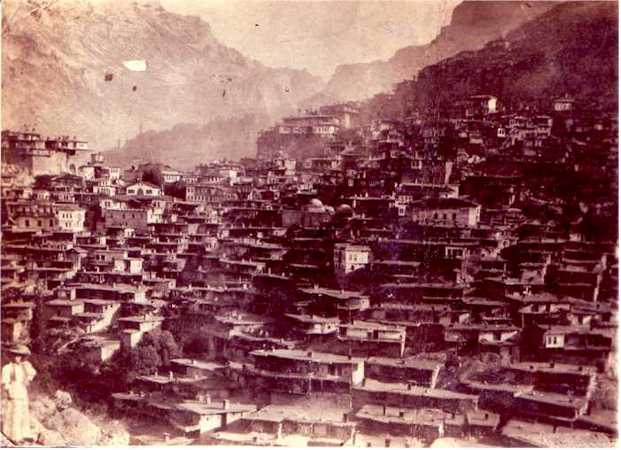
the mountain extending into the valley, the town rambling
up around it so that it was impossible for him to see the
homes of friends and relatives on the other side of the
slope. He would remember the thousands of little
beehive houses built one against the other, and tier upon
tier, perched and clinging to the side of the mountain,
the flat roof of one serving as the front yard and
playground of the house above. The steep, narrow
streets zig-zagged heedlessly up and down. He would
see in his mind’s eye the government buildings below
on the banks of the river, occupied by the few Turkish
officials and their families. And he would remember
with delight the family baghtche, the vegetable garden
and orchard beside the river, and the family vineyard
high up on the opposite slope of the mountain.
Forced to leave his home and his
town at the age of eleven, the boy would cherish
throughout a lifetime the shadowy memory of his parents.
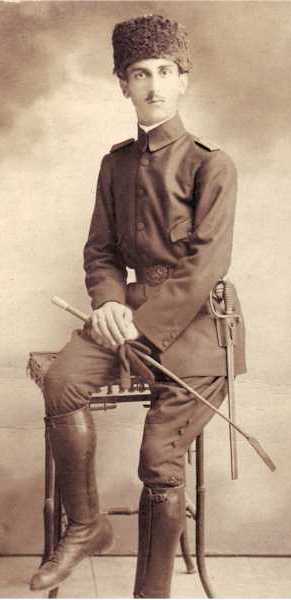
His father was tall, a handsome man with thick black hair
and a luxuriant moustache. He had the kindest eyes
the boy had ever seen and gentle ways about him. In
his company the boy felt secure from the stern discipline
of his mother. He owned a farm on a plateau a
day’s journey from the town, cultivated by a Turk
who shared in the crops of wheat and barley and the other
products which supplied the family’s needs. In
addition, his father had a store down in the Cilician
Plain, and there, as a merchant, he lived from October
through May, leaving his family in the care of his wife.
If the boy would remember his
father for his gentle and affectionate ways, the memory
of his mother would be of a loving but stern
disciplinarian who, in the absence of her husband, had to
be both father and mother to her family of five children,
for the boy soon had two brothers and two sisters. Although
her role was subordinate to that of the male and the
older women of the family, especially the mother-in-law,
she managed her household with a firm and capable hand.
Treasured family pictures of her show an attractive,
modishly gowned young woman. She was intelligent,
an able housewife, a good seamstress and needle woman,
and a faithful and active member of the Protestant
church. In an age when women were expected to
manage only their own homes, she transacted the business
of the family farm during her husband’s absence.
Her father was one of the most
prominent men in town, an influential leader of the
community and of the Protestant church which had been
established with the help of the American missionaries in
1880, and of which he was a charter member. He was
a short, powerfully built man. In his old age when
I came to know him in Pasadena, he was an impressive
figure, reminding one of his immaculate attire, white
goatee and moustache, of Clemenceau. In those days
he came to be known as the Patriarch of the Hadjintsis
– the people of Hadjin – and the great heritage
he passed on influenced his grandchildren, especially the
boy.
He was a man of substance and
maintained two homes, one in Hadjin and the other in Adana,
where he and his two sons had a mercantile establishment.
Unlike the men of his era and region, he had traveled
extensively, and had made a pilgrimage to Jerusalem with
his wife and eldest daughter, the boy’s mother.
From then on he was known as Hadji Agha, the title Hadji
being conferred on all those who made a pilgrimage to Jerusalem,
and Agha, a title of distinction in Turkey; the
boy’s mother whose name was Mariam – Mary
– would be known as Hadji Mariam for the rest of her
life. Hadji Agha had also gone to the Paris
Exposition of 1900 and later to the United Statesto visit
his younger brother who was a merchant here. He had
returned with fantastic tales full of praise and
admiration for the Landof Freedom.
One of the boy’s earliest
recollections was of the first Christmas after Hadji
Agha’s return from America. As in all Armenian
communities Christmas in Hadjin was a holy festival.
With the coming of the American missionaries in 1865,
some western customs had been added to the ancient rites.
In the mysterious hush of Christmas Eve, long lines of
children from the Protestant church, with lighted candles
in their hands, moved like a procession of glowworms up
and down the streets now carpeted with snow. The
silent night echoed with their angelic voices singing the
well-loved carols, imparting to these faithful believers
the illusion of a shepherd’s field of long ago and
of the heavenly host. Later, the sexton of the
Mother Church, a lantern swinging in his hand, would
zigzag his way across the mountain slopes, chanting the
ancient hymns, pausing at intervals to announce the great
news: Avedis – I bring you good tidings of
great joy. To many, the services at the church on
Christmas morning were anti-climactic; the Christ Child
had come in the miracle of the night before.
After church, families always
gathered together, but on that first Yuletide after Hadji
Agha’s return from America, when the boy was about
four years old, something new was added to the
festivities. In his grandfather’s home where
his parents had taken him, there was the usual noise and
clamor of his many cousins, the ritual greetings, the
chatter of the uncles and aunts, and the bountiful feast
spread upon the patriarchal board, but when the boy went
to kiss his grandfather’s hand, Hadji Agha was
nowhere in sight. Then suddenly there came a break
in the conversation, a hush, and down the stairs with a
“Ho-Ho-Ho!” came the strangest little man the
boy had ever seen. He had white eyebrows and a
flowing white beard and moustache. He wore a red
and white suit and a red cap, and over his shoulder he
carried a red bag. The rumbling sounds rising from
his lips and the strange clothes he wore terrified the
boy, and in the twinkling of an eye had had dived in the
direction of the settee and hidden under it. It was
with difficulty that his parents coaxed him out, and it
was with great reluctance that he accepted the gift of
fruit and candy wrapped in red gauze which the strange
apparition presented him. Later, when his
grandfather made his appearance, he told the boy that in America
there was a Santa Claus who always appeared at Christmas
time and presented all good little boys and girls with a
gift.
One of the marvels of the New
World remained beyond the boy’s comprehension, even
after this marvel had been viewed, examined, and its
function explained. A certain object which Hadji
Agha had brought with him from America and installed in a
tiny room on the upper floor reserved for his use alone
became a source of mystery and fascination, not only to
the boy, who was a frequent visitor at the patriarchal
home, but to his cousins who lived there. Every day
Hadji Agha spent some time closeted in this small room,
but as the door to it always remained locked, the boys
had no way of satisfying their curiosity. To ask
their grandfather point blank concerning the contents of
the room would have been a serious breach of established
custom. So they bided their time until one day,
forgetful for once, Hadji Agha left the door unlocked.
With what expectancy they tiptoed into the room, their
eyes wide with excitement! With what disappointment
they beheld only a strange box-like seat in the middle of
the small room, a cover upon it set with hinges. They
peered around it and behind; they lifted the lid and
gazed down the round hole; they stood there speculating
on its function until their grandfather surprised them
there, and at long last unraveled the mystery for them.
In America, he said, every home had a bathroom, and in
every bathroom there was this object called a
water-closet. In Hadjin, he said, with no running
water in the homes, such a contraption would be
impractical. But Hadji Agha was a most ingenious
individual. He had solved the problem by installing
a pipe which went from the small room all the way down
under the house, and he had the water hauled in
containers from the fountain in the street up to his own
privileged “inner sanctum”.
The seasons brought their own
delight to the boy. In the spring the mountain
slopes and meadows were a riot of color: blood-red
poppies sprinkled thickly across the grass, nodding
asphodel, lavender candy tuft and wild mignonette. The
glory of a flaming pomegranate tree in blossom, its
flowers a deep scarlet, was a joy to behold. The
boy and his friends would tumble in these fields of color
and roll down beside the little waterfalls bordering
them. But best of all, spring meant Easter and the
joy and excitement of the Holy Season. He loved the
services in the church and the stories of Jesus’
Passion. He loved the musical cadence of the
traditional greeting: Christ is Risen from the
Dead, and the response: Blessed be the Resurrection
of Christ. But the high moment came after dinner
when the battle of the Easter eggs began. Each
member of the family had a colored egg, and with it he
tried to crack the eggs of all the others. With
what care and concentration each egg was selected from
the basket, tested by gently tapping it against
one’s teeth and listing to the tick-tick. There
was always one whose egg cracked all the rest and to him
went the spoils of battle, all the cracked eggs. Later,
the battle was carried on out in the streets. This
tradition is still a most cherished one in our family.
Summer and fall were the
boy’s favorite seasons for then his father was home.
They would go to the farm and to the boy, who had never
been out of Hadjin, the day’s trip would seem like a
journey across the world. They would spend the
night with their Turkish tenant farmer, sharing the
family’s one room. The next day his father
would attend to the fields of grain, the walnut trees,
and the livestock which provided them with their winter
provisions. At home, in the baghtche, they would
spread large sheets under the cherry and mulberry trees
while his father or a friend climbed the tree and knocked
on the limbs with a long stick. The fruit came
showering down to be dried and put away for the winter.
Tomatoes were gathered, and okra and squash and eggplants
to be prepared for preservation. Grapes, too, were
gathered, and after feasting on the fresh fruit they
would spread the clusters on sheets and dry them for
raisins which, mixed with walnuts, would help to while
away the long winter nights.
With the departure of his father
and the opening of school, the boy began the routine of
winter, and now he was closer to his mother and her many
tasks. There was no running water in the homes and
the boy would run several times a day with his mother to
the fountain four streets below. There she would
fill the containers with the water that would be used for
drinking, cooking, and cleaning. Many women took
their clothes down to the river to wash. The public
baths were down there, too. They seemed like a
palace to the boy, the marble floors and basins, the
pools, and the steam with its indescribable smell, damp
and clean, swirling around the disrobed figures and
imparting to them a ghost-like appearance.
There was little marketing to be
done, for almost all the provisions came from their own
land and were kept in the store rooms. But bread
had to be baked, and this event was one of the high
moments of the week for the boy. His mother kneaded
the dough in a wooden trough either at home or at the
community oven and marked the loaves with her own special
symbol. Every family had its own mark, a cross, a
circle, a triangle. For his services the baker
received a predetermined number of loaves. Oh, the
heavenly aroma of freshly baked bread! To the boy
there was no delicacy to compare with it. He would
gorge himself on the day the bread was baked, and on the
following days, upon his return from school, his favorite
snack would be the heel of the loaf spread with butter
and sprinkled with sugar.
Next to his home and that of his
grandparents, the boy’s earliest memories would
center around the Protestant church. The boy’s
paternal grandparents, too, were devout Protestants.
His father’s younger brother, Samuel, was a minister
of the Gospel, serving first in Turkey, later in the United
States. So the boy’s homelife included daily
devotions, grace before meals, and regular attendance at
church on Sunday and mid-week services. The boy
would especially remember these mid-week services when he
sometimes accompanied his grandfather, walking in front
of Hadji Agha with a lantern in his hand to light the old
man’s way through the dark and narrow streets.
Unlike the Mother Church, there were benches here, the
men sitting on one side and the women on the other.
The boy always sat on the floor in front of his
grandfather, and if his head nodded during the long
service his grandfather’s knee, sternly nudging him,
awakened him to the observance of the time and the place.
This early religious training would illumine his tortuous
path through life in the years ahead.
Like all Armenians who cherish
education, the boy’s mother carefully supervised his
schooling. With what pride she saw him off every
morning! With what concern she admonished him when
his reports were not as favorable as she had hoped they
would be! Especially would he remember the cold
winter mornings when, after drinking the hot soup his
mother had prepared for breakfast, he was put in the
saddle-bag slung over their horse, and taken to school
through streets deep in snow. The four of five
years spent in the parochial school would be the only
formal education he would ever receive, for the gap
created by the years of the Great Deportation and Exile
would never be bridged. His achievements in later
years would be due to his own native intelligence, his
determination, and his indomitable spirit.
The boy was five years old in the
spring of 1909 when the Adana massacres began. Before
it was over the Turks had butchered 25,000 Armenians,
among them his father’s youngest brother. When
the news of the massacre and the violent death of the
youngest son reached home, the boy’s paternal
grandfather suffered a heart attack and died.
How can one explain such deeds and
events to those who all their lives have lived in a
country where human life is highly valued, man’s
religious beliefs respected, and his dignity honored?
How describe to the Western mind what the German writer,
Franz Werfel, called “the incomprehensible destiny
of the Armenians”? This is not a lesson in
history; I can only present a bare outline of what
happened to the Armenians in Turkey. Through the
centuries, the Armenian question had been the thorn in
the Turkish flesh. During the latter part of the
nineteenth century, Abdul Hamid, the bloody Sultan, had
tried to solve it through wholesale massacres. With
the coming of World War I, the young Turks, who were now
in control of the government, decided to end the Armenian
question once and for all. More sophisticated,
better disciplined and organized than the rude forces of
Abdul Hamid, they planned and carried out the first
genocide of the century. First the leaders of the
Armenian communities were snatched from their beds and
taken away, never to be heard of again; next, the
able-bodied Armenians serving in the Turkish army’s
labor battalions were destroyed.
With the leaders and the fighting
men eliminated, the Turks began the final phase of their
program. They called it deportation, this mass
uprooting of a people from their homes and their
so-called re-settlement in the arid deserts of Syria.
Within a few months after the order had gone out of Constantinople
in April of 1915, a million and a half Armenians were on
the march. According to Henry Morgenthau, American
Ambassador to Turkey, they could be seen winding in and
out of every valley and climbing up the sides of every
mountain. “During the first days of the march
they were robbed by the Turkish villagers and peasants;
then by the Kurds who, says Lord Bryce, committed
blood-chilling atrocities. “It depended on the
whim of the moment,” he said, “whether a Kurd
cut a woman down or carried her away into the hills.
The babies were left on the ground or dashed against the
stones.”
It is pointless to describe or
elaborate on these atrocities. Such graphic
descriptions are too horrible and offensive to man’s
sensibilities. In a measure they defeat their
purpose. All I can say is this – imagine the
worst atrocity man can inflict upon man, the most
degrading indignities that can be visited upon a woman,
and still you will not begin to plumb the depths of the
suffering endured by the Armenians during these
deportations.
In Hadjin, the order of
deportation came in the spring of the year that will live
forever in the memory of every Armenian, 1915. The
boy was eleven years old then, and to an eleven-year-old
even a cataclysmic act such as the Great Deportation
carried with it a certain measure of excitement. He
would remember that his mother cried when his father came
home with the news that they must leave, but she had also
cried a short while before when one of his little sisters
had died. To him, the unusual activity in the town,
the farewells to those who were leaving at once, had the
aura of adventure.
The 28,000 Armenians of Hadjin
left in groups at intervals of a few days. The
boy’s family started out with a horse and two
donkeys, the absolute necessities packed in saddle-bags,
the foodstuff in baskets. His father and mother and
the boy himself carried packs, while his two younger
brothers and sister rode the animals. Only in the
light of later years would the boy be able to interpret
the expression in his parents’ eyes as they locked
the door of their home, gazed at it long and silently,
then wordlessly turned away and began the first part of
the march down to the Cilician Plain.
There were other children in the
caravan and much running back and forth, even though the
grim gendarmes herding the procession tolerated no play.
But it was not long before the heat of the day and the
arduous climb began to tire the boy. No rest
periods were allowed, no lagging behind. Relentlessly
the gendarmes prodded the line of men, women, and
children. When, in late afternoon, the boy suffered
a severe nose bleed with no let up in the march, he began
to realize that the adventure he had envisioned was in
reality a grueling ordeal.
The four-year period of exile,
from 1915 to 1919, would remain in the boy’s memory
as a kaleidoscope of events and experiences, sometimes
vivid and painful, at other times hazy and unreal. There
are no details in these memories, no frills, only the
bare outline as an eleven-year-old or early adolescent
would remember. These are the experiences and
adventures with which his family and friends are
familiar. Through the years, whenever the
conversation has turned to that tragic time, we have been
enthralled, weeping over his trials, then as
spontaneously laughing at an adventure in his struggle
for survival. His dauntless spirit, his complete
self-reliance during those years between the ages of
eleven and fifteen when he was left alone in a world gone
mad, his superb sense of humor which made his ordeal
endurable, and his sublime faith, have been a source of
inspiration to his family and friends. There were
those who came through the holocaust maimed and crippled
in spirit, carrying with them a vengeful hatred which has
eaten away at their hearts like a cankerous sore, but the
boy, thanks to his heritage and his own inner resources,
emerged from those years of fire tall in spirit, equipped
to meet and overcome whatever else life had in store for
him.
Every night they camped on the
side of the road, and every morning they awakened to find
some of the animals stolen, as well as the supplies they
had carried. On the morning of the fifth day of the
march, the family awakened to find their two donkeys
gone. Even the most optimistic members of the
caravan were now aware of what lay ahead. On they
were driven, the strong and the able-bodied pushing
ahead, the sick and the dead abandoned, until they
reached Aleppo, an oasis in the Syrian desert. There
they found gathered thousands of Armenians from every
corner of Turkey. Every day thousands more arrived,
and every day convoys and caravans were formed and sent
on their way east toward Der-el-zor in the Mesopotamian
desert. By now, Hadji Agha and his family had
established themselves in Aleppo. Hadji Agha had
influential friends everywhere and he had managed his way
to semisafety.
Perhaps it was the hope that they,
too, would remain in Aleppo that kept the boy’s
family from joining the early caravans moving east to
Der-el-zor, though his mother was anxious to reach
whatever destination was to be theirs and settle down,
and to this end she daily urged her husband to move east.
But here, miraculously, fate took a hand, and for one
reason or another they remained in Aleppo for the time
being. When it was all over, and the history of the
Great Deportation was put together from bits and scraps
gathered from the survivors, it became known that of the
hundreds of thousands who had journeyed to Der-el-zor and
the desert just beyond almost none survived, that typhus
raged, and that those who survived the plague fell under
the sword. To this day, the name of Der-el-zor
stabs the heart of the Armenian whenever it is mentioned.
So it was that the boy’s
family, robbed of their horse and the last of their
belongings, were put into a boxcar going to Damascus.
The boy would not remember how long the journey took or
how many were in this particular convoy, only the fact
that camels were waiting for them in Damascus, and
mounted on these beasts the caravan moved some thirty
miles farther south into the desert to the small village
of Basra-el-Hareer. There they were all crowded
into an old abandoned barracks with broken window panes
and the roof open to the sky. There was no food, so
the boy went into the Arab village with a pail in his
hand, begging for food from door-to-door. Whatever
the kind-hearted Arab woman was able to spare from her
own meager fare, he dumped into his pail. When the
pail was nearly full, he sat behind a bush and gorged
himself on the mixture of food before him until he became
ill. To this day there is remorse in his voice as
he recalls how he lied to his mother when she urged him
to partake of the food, telling her he was not well.
At other times he would go out into the fields and gather
grass which his mother would boil, and this in a measure
would appease their hunger.
And now typhus began to rage.
Every day many bodies were removed from the barracks and
disposed of in heaven knows what manner. The
boy’s mother was among the first to go, and
immediately after her, his baby brother. By now he
had become well-acquainted with death for they lived
intimately with it and often welcomed it with relief.
Then his father was taken into the labor battalion and
the boy was left alone to care for his younger brother
and sister. Because he now had to take care of the
little family, he became expert at begging food from the
charitable Arabs. On Fridays, the Moslem holy day,
he went to the cemetery where the Arabs brought food for
the poor in memory of their departed dead. In this
way the eleven-year-old boy was able to care for the
needs of his brother and sister.
The story now moves to Damascus.
A distant cousin, hearing of the boy’s plight
through the caravans constantly moving to and fro,
somehow managed to get to Basra-el-Hareer and took the
children back to the one room in Damascus he called his
home in exile. Eventually it became impossible for
him to provide for the children during those days of
starvation and death. The two younger ones were
placed in an orphanage which had opened its doors to
those left alone to wander in the streets. The
cousin wanted to place the boy in the orphanage, too, but
this the youngster refused. He was twelve now, and
could manage on his own.
Now began a period of completely
incomprehensible to us living in a sheltered world.
The boy’s home was the streets, teeming with
children and adults who were homeless and displaced like
him. Sometimes it was a government building which
was opened to shelter these dispossessed, then an open
square where tents had been pitched. There was a
spirit of helpfulness everywhere. Those who had
been separated from loved ones went from group to group
searching, inquiring, and in this way families were often
reunited or the whereabouts of loved ones made known.
The boy learned in this way that his maternal uncle,
Hadji Agha’s younger son, had escaped from the labor
battalion and was in hiding in Damascus.
The boy managed to find his uncle
and, seeing his nephew’s plight, this uncle tried to
“set him up in business.” He gave him a
silver coin with which the boy bought twelve loaves of
bread, placed them on a wooden board suspended from his
neck, then went to the station to sell them to the
soldiers in transit. How delicious was the aroma of
the bread to the boy who was forever hungry! What
self-restraint he exercised to keep himself from
devouring one of the golden loaves! He had promised
to give an accounting to his uncle, and he could not eat
until all the loaves were sold but one. That would
be his profit and he could eat it with a clear
conscience. But on the way to the station he broke
off and ate tiny pieces of crust from this loaf or that
which, far from appeasing his hunger, further tormented
and tantalized him. Then he was at the station,
surrounded by soldiers. They almost assaulted him,
lured by the aroma of the fresh bread, jostling his tray,
grabbing the loaves, holding out their coins for change,
until the whistle blew. With the bread already in
their possession and the bewildered, harassed boy before
them fumbling to make change, they turned and ran to
their train, leaving him with an empty tray and not one
coin in his hand. Still hungry, dejected, and
ashamed, the boy would not report to his uncle, but
continued in his solitary search for food.
It was after that that he spent a
night or two in a bakery, tending to the oven in return
for a corner in which to sleep and a loaf or two to
appease his hunger. But he must have eaten more
than his allotted share, surrounded as he was by row upon
row of the golden loaves, and in the morning he was
dispatched by the baker with a swift kick. He was
preoccupied by thoughts of food and how to obtain it.
One day as he was passing a grocery store, he saw in
front of it an open barrel of thick syrup. Like a
magnet the barrel drew him, and he walked back and forth
in front of it, scheming to get some. His mind made
up at last, he rolled up his sleeve, approached the
barrel, stuck his bare arm into the sticky syrup, drew it
out, then ran for dear life as the storekeeper chased
him, shouting and cursing. At last he found a dark
alley where he sat down and licked his arm. For
that day at least he was happy.
Compared with Damascus, life in
Basra-el-Hareer had been easier for the boy, so he
decided to join the caravans which brought wheat from the
village to the great city and return to the village with
them. Luckily for him, the caravan that day was led
by the son of the village Sheikh. He offered the
boy a place to sleep and three loaves of bread a day in
return for his labor. The old Sheikh was a kindly
man with many wives and children, and from the first he
felt fatherly toward the Armenian child. The
boy’s job was to take care of the animals and he
slept with them in the barn. He accompanied the men
to the wheat fields, performing the most menial tasks,
following the animals to gather the droppings which would
be dried and used for fuel. He dressed like the
Arabs in a long gown and flowing headgear, and his hair
grew as long as theirs. Warm and affectionate by
nature, hardworking and conscientious, he was soon like a
member of the Sheikh’s family. By now he had
forgotten his Armenian and spoke-only Arabic.
So the months and the years
passed, and the world from which the boy had come became
blurred and half-forgotten. Now he lived within the
compound, and he was told daily that it he became a
Moslem he could truly become a member of the
Sheikh’s family and marry one of his younger
daughters. But somewhere deep within the boy were
the old, old memories of home and church, of Christmas
and Easter, and the Armenian’s centuries-old faith
in Christ. So, finding one pretext or another, he
put off his acceptance of Islam.
Then the caravans brought the
great news from Damascus: the war was over; the
British were in Damascus; the refugees were gathering in
that city to be returned to their homes. Then one
day an Arab neighbor who had known the boy’s father
during his brief stay in the village brought news that
affected the boy personally. His father had been at
the caravan terminal seeking out the men from
Basra-el-Hareer, asking news of his son.
The boy feared that the Sheikh
would put obstacles in his way, unwilling to lose a hard
worker who labored without pay, as well as a prospective
son-in-law, so he decided to run away. Early one
morning as the men set out in the dark toward the fields,
he dropped behind, and after waiting awhile, started out
toward the railroad station. All day long he
walked, resting whenever he came to a shady spot, and by
nightfall he reached the station. He had with him
the few coins which had been given him during the Arab
holidays, but he wanted to save his money, so he
concealed himself in the dark and when the freight train
finally pulled in he quickly climbed up on top of a
boxcar and was on his way to Damascus. It can be
freezing cold in the desert at night and the boy,
stretched out on the boxcar, shook with cold, wrapping
himself more snugly in his long robe. Sleep did not
come easily, for there was the rattle of the wheels, the
monotonous wail of the whistle, and once a choking
sensation when the train passed through a tunnel. At
that moment he thought his end had surely come. Then
the tunnel was left behind and he was breathing the clean
cold air of the desert, gazing up at the starry sky.
It was not yet dawn when the train reached Damascus.
The boy jumped down, ran to a corner, lay down, pulled
his gown over his head, and pretended to sleep. Soon
soldiers wearing uniforms he had never seen before
approached him, shook him, then pushed him out of the
gate, which was exactly what the boy had hoped would
happen.
As he walked toward town, he came
to a fountain where a crowd had gathered. Though he
had forgotten his Armenian, he nevertheless realized that
these people were Armenian refuges. He asked them
in Arabic the way to the refugee camp. In no time
at all he was at the camp, but at the gate he was stopped
by the soldiers in the strange uniforms who, he learned,
were British. They thought he was an Arab and would
not permit him to enter. When at last they were
convinced that he was a refugee returning to find his
father, he was permitted to pass through the gate.
It was the largest camp the boy
had ever seen. Moving from barracks to barracks
filled with family groups, he searched for his father.
Suddenly he was face to face with a man who resembled his
father, but oh, so much older, the eyes so much sadder.
As completely Arab as the boy looked in his long hair and
flowing gown, his father recognized him at once. Locked
in each other’s arms the years were spanned, and the
remnant of the family united. But before he could
join his father, he was taken away by the British
soldiers, undressed, showered, deloused, and issued a
blanket and old, but clean, clothes and shoes. After
years of walking barefoot, his feet felt strangely
confined.
There is an interlude in Damascus
before the return to Hadjin. I tried to imagine
what these refugees did, sitting there idly day after
day, caught up by forces over which they had no control,
until my husband reminded me of the summer of 1968 when
we went to Jordan and visited the huge camp at Bekaa,
near Jerash, filled with refugees from the 1967
Arab-Israeli War. Here were Arabs, sitting idly,
rehashing the details of war and their bitter lot,
smoking their pipes, playing backgammon. The women
were engaged in the eternal tasks of wives and mothers at
home or in exile, trying to provide the material comforts
for their families, which the children, oblivious to the
cares of their elders, played the games children have
played since time began. Do not think therefore
that my story concerns an age gone by. It is
happening today.
In Damascus the boy was restless,
for it was contrary to his nature to sit idly day after
day. He persuaded his father to provide him with a
shoeshine box and every day he went to the main
thoroughfare, took his position, and earned a few coins.
My husband relived this experience when we visited Damascus
a few years ago. There, on that same thoroughfare,
were boys sitting behind their homemade shoeshine boxes,
hopefully waiting to earn their daily bread. It is
in such moments that my husband knows the past was not
just a dream.
In the spring of 1919, the
refugees were returned to their homes, their safety
assured by the British and French forces occupying what
was left of the once mighty Ottoman Empire. They
returned home grieving over the loss of loved ones, yet
buoyed by the hope of beginning life anew. As the
long caravans of horses and camels moved across the
glorious mountains, there were those who even burst into
song at the thought of a life to be lived in peace and
without fear.
Of the 28,000 who had left Hadjin
in 1915, barely 5,000 returned in the spring of 1919.
The first reality hit them as they crossed the little
stone bridge and found their town burned to the ground,
only a few houses left standing. How they lived
during that year is difficult to imagine. There was
no lumber with which to build or rebuild. Commodities
were scarce. The churches had burned, and the
people gathered wherever there was a room large enough to
accommodate the faithful. Together they offered
their thanks to God who had brought them safely home.
The American missionaries returned, providing such work
as sewing and weaving to the needy and a home to the
orphaned. The boy’s father had the farm well
in hand soon after their return, and until they could
rebuild their home, they crowded with other families into
one of the buildings that had escaped destruction. Hadji
Agha and his family had remained in Adana, but his older
son, Avedis, had returned to Hadjin to look after the
family’s interests. The boy’s father was
very close to this brother-in-law, and there was love and
respect between them.
There is an episode during this
period which our children have never tired of hearing.
The boy dearly loved his Uncle Avedis who must have had a
way with him. Like his father, Hadji Agha, he was a
born leader of men. He always dressed colorfully,
and even in exile he had managed to keep his handsome
appearance. By now no one had any decent clothes
left. What the British had given the boy in Damascus
had been patched and repatched and was now unfit to wear.
So the boy’s father had the heavy blanket given by
the British made into a pair of baggy pants for him.
I did not know until I began to
recount this story that our daughter had written and
preserved an account of her father’s pantaloons and
accessories when she herself was about the age he must
have been at the time, fifteen. She brought it to
me when she learned I wanted to preserve the story of her
father’s early years. She tried to remember
the words her father used as he recounted the tale, and
which she, a teenager herself, recorded.
“My Uncle Avedis,”
begins the account, “was fortunate enough to have
money when we returned from exile, and he was good to me.
How I did love him! Whenever I went to him with
some need, he would say: ‘Hold your head high, look
into my eyes, and tell me what you want.’ So
one day when I felt I just had to have some shoes, I went
to him, shy and embarrassed. He repeated his
command to me, so I did look him straight in the eye and
said: ‘Uncle Avedis, I need a pair of
shoes.’ ‘Fine,’ he said, and off we
went. Because of the war there was no leather, so
our cobbler used pigskin, and he took my fit and made my
shoes. I was so happy I didn’t even notice
they were so hairy they swept the floor as I walked.
To complete my outfit I wanted a red fez with a black
tassle – all the boys had them, and I did so want
one. Again my uncle took me to the shop and at last
my outfit was complete. But after a while the
constant wear was too much for my blanket pants and the
knees wore out. I simply couldn’t ask my
Uncle Avedis for another thing, so I went to my father
with my need and he came up with a solution. ‘Turn
the pants around,’ said he, ‘for people only
look at you when you are coming toward them, and by the
time you pass, they’ll by looking at someone else
and will never see the holes in the back. Besides,
he added, ‘the holes will make the pants airy and
keep you cool.’ When a few months later my
Uncle Avedis took me to Adana to live with my
grandparents, I was still wearing my pantaloons. But
Haji Agha was not impressed with my ‘country-boy
outfit,’ and to my great joy ordered for me a
beautiful brown corduroy suit.”
Why had the boy left his father
and his beloved Hadjin to go to Adana? The events
of late 1919 and 1920 are beyond comprehension. This
time the destruction and massacre that took place were in
a measure caused by the betrayal of the French and
British who, after guaranteeing the safety and
rehabilitation of the Armenians, withdrew from the area
and left the Christians once more at the mercy of the
Turks. And why? Because after the war Turkey
was reduced to a fraction of its former size and many
Turks were rebellious against the Western Powers. There
developed a strong militant nationalism whose slogan was
“Turkey for the Turks.” It was led by
Mustafa Kemal who would later be known as Ataturk, the
Father of the Turks. These new “Young
Turks” defied the allies and ignored the terms of
treaties; Britain and France, eager to establish friendly
relations with the new regime in order to obtain
diplomatic and commercial concessions for themselves,
maintained a strict neutrality, withdrawing from the
occupied areas in many instances. So the Turks,
aware that whatever action they took against the
Christian minorities would remain unchallenged by the
great Christian powers of the West, began to exterminate
or drive out the handful that had survived the
deportation and returned home.
It was because of the wild rumors
and the reports that the French were withdrawing that
Uncle Avedis asked his brother-in-law’s consent to
take his sister’s only surviving child to Adana, and
the boy’s father, aware that his son’s safety
and future lay away from Hadjin and with his
grandparents, reluctantly consented. It must have
been early spring 1920 when his uncle took the boy to Adana.
Though by now the fate of Hadjin seemed certain, for the
Turks were massing their forces in the mountains round
about, Uncle Avedis returned to the town to participate
in its defense. For seven months, April to October,
the town was besieged, until the remnant that had
returned literally starved to death or fell under Turkish
fire. The boy’s father and his uncle were
among the fallen martyred heroes.
The period from the spring of 1920
to the summer of 1921 was difficult for the boy. Sixteen
years old now, he was well aware of the significance of
the events surrounding him, of the bitter fighting in
Hadjin, and eventually of the death of his father and
uncle. But now he had the love of his mother’s
family and the companionship of his cousins. Here
his grandfather began to instill in him many of the
precepts which would serve as guidelines in his later
life. He attended school with his cousins and tried
to bridge the five-year gap created by the deportation. But
it was an insurmountable task; he had forgotten how to
read and write, forgotten even the Lord’s Prayer.
He joined the Boy Scouts and for the first time felt the
joy of just being a boy.
In June of 1921, at the age of
seventeen, the boy embarked from Mersin, a seaport near Adana,
for the United States. His father’s younger
brother, Samuel, who had gone to the United States to
complete his theological studies and was now the minister
of an Armenian church in Troy, New York, had been able to
contact him and had sent him his fare. With him
traveled two of his cousins, the sons of Uncle Avedis,
who had been sponsored by their great-uncle, Hadji
Agha’s younger brother, a prosperous merchant.
At last the tragic past was behind him; he was on his way
to a land where he would live without fear. But at Ellis
Island where all the steerage passengers were taken, the
most cruel blow of his young life awaited him. There,
in full view of the New York skyline, that Promised Land
of all the dispossessed, he was told that his minister
uncle lacked the material means to guarantee his future.
He would be sent back.
To us, his family, this has always
seemed the crowning blow of all that he had endured.
To be on the threshold of Freedom and be refused
admittance can be appreciated only by those who have
themselves found refuge in this blessed land. He,
himself, confesses that he lived the darkest hours of his
life when he was separated from his cousins who had gone
ashore, carrying with them the one suitcase all three had
shared, while he was taken to a ship sailing for Athens
and thence to Smyrna.
Alone and with only three dollars
in his pocket, with no belongings except the clothes on
his back, the boy reached Smyrnaon the Mediterranean
coast of Turkey. He was able to find lodging in a
khan, an inn near the harbor where the kindhearted
innkeeper allowed him to spend the night in the stable.
The next day being Sunday, he followed the habit of a
lifetime and sought out the Armenian Protest Church
where, conscious of his soiled and wrinkled clothes and
ill-kempt appearance, he sat in the corner of the back
row. Here he reached the depths, alone in a strange
city without a single soul who knew or cared about his
existence. But the service was refreshing to his
soul. As he turned to leave the church, he was
stopped by a beautifully dressed, stoutish lady who,
realizing that he was a stranger, began to question him.
Her kind heart moved by the boy’s tale, she took him
to her carriage where her daughter and two sons were
waiting for her. At home, the boy was made to bathe
and put on clean clothes furnished from his young
host’s wardrobe. After much
questioning at dinner, it was discovered that the lady
had heard of Hadji Agha and his leadership in the
Protestant church in Turkey. She arranged for the
boy to enter the American International Collegein
Paradiso, a suburb of Smyrna.
With no knowledge of English, his
elementary education at only fifth grade level, the
seventeen-year-old youth was completely at a loss
academically, but the school authorities were familiar
with the plight of boys such as he, and he was allowed to
attend classes and absorb whatever knowledge was within
his comprehension. In return, he cleaned the rooms
of several faculty members and set the breakfast table
for the boarding students. All the while his
letters to his uncle were crossing the Atlantic, voicing
his fears, his desperate need to get away from Turkey and
reach the haven of America. In July of 1922, a
second affidavit from his uncle reached him, and with the
help of his new friends and money borrowed from his
classmates, his passage was booked. On the eighth
of August, 1922, at the age of eighteen, he arrived once
more at Ellis Island.
This time the period of anxious
waiting and uncertainty did not last long. A
wealthy member of his uncle’s congregation had made
it possible for the minister to assure the authorities
that his nephew would not become a public charge. At
last the golden doors were opened. At last the long
pilgrimage from Hadjin in the Taurus Mountains to the Land
of Freedom had come to an end.
Fifty years have passed since that
memorable day when the youth first set foot on this
modern Promised Land. They have been good years,
lived without fear in the atmosphere of freedom. They
have enabled him to fulfill his potential as a man,
husband, father, grandfather, friend, and citizen of his
beloved United States of America.
BIBLIOGRAPHY:
The Forty Days of Musa Dagh –
Franz Werfel
Beginning Again at Ararat –
Dr. Mabel Elliott
Vital Issues in Modern Armenian
History – Armenian Studies
Martyrdom and Rebirth – 1965
Report
Ambassador Morgenthau’s Story
– Henry Morgenthau
In Our Time – Ernest
Hemingway
The Treatment of the Armenians in
the Ottoman Empire – Lord Bryce
The Armenian Community –
Sarkis Atamian
At the Mercy of Turkish Brigands
– Eby
Hadjin and the Armenian Massacres
– Rose Lambert
The Smyrna Affair – Majorie
Housepian
Neither to Laugh Nor to Cry –
A. Hartunian
Letters from Cicilia – Alice
Keep Clark
The Blight of Asia – George
Horton
A Note about the Author:
For thirty-eight years Ermance
Rejebian has been contributing to the cultural life of Dallas
and the entire Southwest through her oral book reviews,
and lectures. Born in Bursa, Turkey, of Armenian
parents, Mrs. Rejebian lived as a child through the
tragic days of World War I, survived the holocaust
visited upon her people, and when the war was over, at
the age of fourteen, came to the United States, after a
brief stay in England. She attended the Los Angeles
public schools, U.C.L.A., taught in Beverly Hills, and
upon her marriage came to Texas, living first in Houston,
later in Dallas. The Rejebian’s have two
children, a son and a daughter, and six grandchildren.
Through the years, Ermance Rejebian’s influence has
been widely felt and recognized. In 1943, when a
survey was made to determine Dallas’ important
leaders – those responsible for molding public
opinion and inspiring Greater Dallas to action – the
list included her name. In 1951, Mrs. Rejebian was
honored as one of nine outstanding women of the Southwest
by reason of “her accomplishments in civic, social
and economic fields, which identify her as a
leader”. In 1959, the Jane Douglas Chapter of
the D.A.R. presented her with its first Americanism Medal
“in recognition of the many contributions she has
made as a naturalized citizen.”
Hadjin Turkey
Copyright H.M.
Keshishian 2006.
Last revised: June 10, 2006.
|